Home / 2025 / October
Preserving a Multi-Generation Legacy While Positioning a Portfolio for the Future

Preserving a Multi-Generation Legacy While Positioning a Portfolio for the Future

For Succession Real Estate Partner Len Rifkind, real estate is more than an asset class—it is a multigenerational legacy. His grandfather, George Baker, arrived at Angel Island in 1932 with no English, no connections, and a disabled arm. Within two decades, he became a successful Bay Area developer, building subdivisions, apartments, gas stations, and retail properties. His determination not only established the family’s foothold in the United States but also shaped an investment ethos carried forward by his daughter and son-in-law, Joyce and Gary Rifkind, both accomplished real estate investors and community leaders.

Len followed in their footsteps, spending thirty-seven years as a real estate attorney and investor, ultimately partnering with Kirk McKinney and later Jeff Farnsworth to acquire more than 110,000 square feet of commercial property. Yet even for a family with deep expertise, the transition of a long-held portfolio brought significant complexity.

In 2024, after Len’s father passed and his mother was no longer able to manage the portfolio actively, the family faced questions familiar to many high-net-worth families:
How do we reduce management burdens without diminishing returns? How do we mitigate risk? How do we make decisions that strengthen, rather than strain, family relationships?

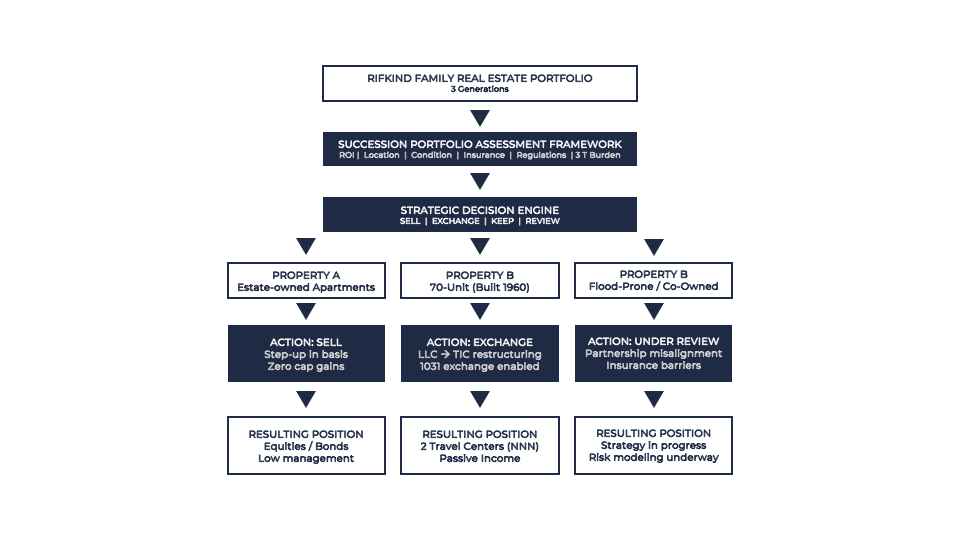
Recognizing the need for a clear plan, Len engaged Kirk and Jeff to form Succession Real Estate, a firm dedicated to guiding families through precisely these transitions. The team worked with the Rifkind family to design a comprehensive succession strategy grounded in objective criteria: property performance and ROI, location quality, required capital improvements, insurance availability, regulatory exposure, and the ever-present “three T’s”—toilets, tenants, and trash.

Strategic Outcomes

Through Succession’s structured evaluation process, three apartment buildings within the portfolio required different paths:

  • Building 1 – Sale and Reinvestment:
    A property owned solely by Gary’s estate was sold immediately following his passing. The step-up in basis allowed the family to avoid capital gains tax, and the proceeds were reinvested with a New York advisor into diversified, low-maintenance assets.
  • Building 2 – Tax-Efficient Exchange and Enhanced Returns:
    A 70-unit apartment building developed by George Baker in 1960 and co-owned by four family branches was restructured from an LLC to a tenant-in-common structure to enable the respective families to exchange, avoid capital gains tax, and reinvest separately. The Rifkind’s exchanged their share into two large travel centers under long-term triple-net leases,doubling their return on investment while eliminating day-to-day management demands. After managing this building for 30 years, Len considers this one of the most successful outcomes of the planning process.
  • Building 3 – Ongoing Evaluation:
    A property in a vulnerable neighborhood prone to flooding, co-owned with a partner at 50% without a formal agreement, remains under strategic review. Succession is guiding risk exposure, owner alignment, and potential resolution options.

The family’s commercial strip center, complicated by environmental issues from a 1950s gas station, is also being evaluated with an eye toward long-term stabilization or disposition.

Impact

Succession Real Estate’s work enabled the Rifkind family to:

  • Reduce management responsibilities
  • Reallocate assets into higher-performing, lower-risk holdings
  • Resolve intergenerational differences with clarity and consensus
  • Preserve the family legacy while positioning the portfolio for future generations

If your family faces similar decisions—or would benefit from an experienced, discreet partner to help evaluate your portfolio—Succession Real Estate stands ready to help.

For more on this topic, contact Kirk McKinney, Principal, at 415-254-2517 or [email protected].

Navigating Succession Planning for Real Estate Families Under the One Big Beautiful Bill Act

For high-net-worth families with significant real estate portfolios, the One Big Beautiful Bill Act (OBBBA) — recently signed into law — introduces meaningful shifts in tax policy that directly affect succession planning. As real estate specialists and legal advisors, our boutique firm views both the opportunities and complexities presented by these new rules. Here’s what HNW families should know — and how to adapt.

  1. Permanent Increase in Estate & Gift Tax Exemption

One of the most headline-grabbing provisions of the OBBBA is the permanent increase of the federal estate, gift, and generation-skipping transfer (GST) tax exemption to $15 million per individual (and $30 million per married couple), indexed for inflation.

For families with substantial real estate holdings, this increased exemption threshold offers a more flexible and less urgent timeline for wealth transfers. Assets well above previous thresholds can now pass to heirs with greatly reduced estate-tax risk, allowing for more strategic generational transfer planning without the pressure of an impending deadline.

  1. Permanence of Key Tax Rates

The Act also makes permanent the TCJA-era lower individual income tax rates, including top brackets, as well as long-term capital gains rates. For real estate families, especially those who realize gains through sales, refinancings, or other dispositions, this stability decreases the risk of future tax increases on capital gains — a key factor when planning exit strategies or legacy transfers.

  1. SALT Deduction Cap Raised Temporarily

From 2025 through 2029, the OBBBA increases the state and local tax (SALT) deduction cap from $10,000 to $40,000 for most filers, although the increase gradually phases out for high-income taxpayers above a certain threshold. While much of real estate succession planning focuses on capital gains and estate taxes, SALT is also important—especially for families in high-tax states. This temporary relief could influence the types of trust structures you choose or where you place certain entities to maximize deductibility during this period.

  1. Trust & Dynasty Planning Becomes Even More Attractive

With a higher, permanent estate tax exemption, trust-based succession strategies, especially dynasty trusts, become more appealing. Keeping assets in a long-term trust permanently reduces estate-tax exposure for future generations and helps ensure the smooth transfer of property. For families already utilizing trusts, it is wise to review the funding, trustee structure, and timing in light of the OBBBA. For those who have not yet used trusts, now may be an ideal time to consider them.

  1. Real Estate Gains & Carried Interest: Stability, Not More Favor

Importantly for real estate investors, the Act does not significantly alter the treatment of real estate–related carried interest: carried interest continues to receive capital gains treatment (rather than ordinary income), provided the relevant holding period is met. This is critical for family offices and operating real estate businesses that rely on partnership structures. The permanence of favorable pass-through and capital gains treatment under OBBBA helps preserve powerful incentives for real estate investment vehicles.

  1. Risks & Strategic Considerations for Succession Structures

While the Act provides significant room for estate and succession planning, there are strategic risks to navigate:

  • Inflation risk: Although the exemption is indexed to inflation, long-term portfolios may still outpace these adjustments, especially in real estate with high appreciation rates.
  • Lock-in effects: For very large estates, timing of gifts or sales may matter more than ever — transferring too early or too aggressively could leave some part of your portfolio exposed if values continue to climb.
  • Coordination with state-level planning: Federal changes don’t erase state-level estate or transfer taxes. Real estate portfolios often span multiple states, so cross-state trust and ownership structures may need to be revisited.
  1. Action Steps for HNW Real Estate Families

Given the new landscape, here are a few steps real estate families should consider now:

  • Reassess your current trust and entity structure (LLCs, family limited partnerships, dynasty trusts), considering the $15 million exemption.
  • Model different gift/sale scenarios to see how far the exemption buffer stretches, especially if multiple generations are involved.
  • Explore the use of dynasty or irrevocable trusts to lock in value while minimizing estate exposure.
  • Use the temporary SALT cap increase (2025–2029) to optimize how you allocate income and expenses across entities.
  • Continue to structure real estate investment through long-term private partnership or operating business structures to preserve capital gains treatment.

Conclusion: A Generational Planning Moment

The One Big Beautiful Bill Act significantly reshapes the succession planning horizon for real estate–rich families. By permanently expanding the estate and gift tax exemptions, locking in favorable rates, and offering temporary SALT relief, the law provides a more flexible and predictable foundation for generational wealth strategies. But it also demands strategic reassessment: legacy structures should be revisited, trust planning revisited, and entity design optimized.

For more on this topic, contact Leonard Rifkind, General Counsel, at 415-308-8269, or [email protected].

Future-Proofing Your Portfolio: Why 1031 Exchanges Are a Game-Changer in Family Succession

For high-net-worth families with significant real estate holdings, succession planning is more than just a legal exercise—it’s a strategic opportunity to preserve wealth, optimize tax outcomes, and position the next generation for long-term success. One of the most effective yet underutilized tools in this process is the 1031 exchange, a mechanism that allows investors to defer capital gains taxes by reinvesting proceeds from a property sale into another “like-kind” asset. When incorporated into a broader succession plan, its advantages become even greater.

  1. Tax Deferral That Preserves Capital and Flexibility

At its core, a 1031 exchange allows investors to defer capital gains and depreciation recapture, often two of the largest tax burdens linked to selling highly appreciated property. For families that have held assets for decades, the unrealized tax exposure can be significant. A properly executed exchange keeps those tax dollars working, allowing you to reinvest 100% of your equity into new opportunities.

This immediate preservation of capital enhances your purchasing power. With more cash available for reinvestment, families can make larger down payments, access more attractive financing, and move into higher-value or better-located properties. Over time, this compounding effect can meaningfully accelerate portfolio growth—especially important for those preparing to transition assets to children or family trusts.

  1. A Significant Estate Planning Advantage for Heirs

One of the most strategic applications of a 1031 exchange emerges at the generational level. Although capital gains are deferred during the investor’s lifetime, properties transferred at death may receive a stepped-up cost basis. That adjustment resets the taxable value of the property to its fair market value at the time of inheritance. In many cases, this means heirs could sell the asset with little to no capital gains tax liability, effectively erasing decades of deferred taxes.

For families that have spent years building extensive portfolios, this is an enormous benefit—one that supports intergenerational wealth preservation while providing heirs with flexibility to hold, refinance, or sell without facing steep tax consequences.

  1. Curating a Portfolio Built for the Next Generation

Beyond tax outcomes, 1031 exchanges provide an elegant way to restructure a legacy portfolio so that it better serves the next generation. Many long-time real estate owners find that their holdings are highly concentrated—for example, multiple small multifamily buildings in a single region. Through a 1031 exchange, families can:

  • Diversify into new asset classes, such as exchanging multifamily properties for industrial, retail, or medical office properties.
  • Expand geographically, reducing market-specific risk and opening the door to stronger growth markets.
  • Consolidate several smaller properties into a single high-value asset that’s easier for heirs to manage.
  • Upgrade into higher-performing or newer properties that require less maintenance.

For families nearing retirement, the ability to move from active management into more passive structures—such as Delaware Statutory Trusts (DSTs)—is especially compelling. These vehicles can generate income without hands-on oversight, substantially reducing stress while maintaining the tax benefits of a 1031 exchange.

  1. Strengthening Succession Outcomes With Professional Guidance

Successfully integrating 1031 exchanges into a long-term succession plan requires coordination between tax advisors, legal counsel, brokers, and investment specialists. That is where a boutique advisory model shines. A firm that combines decades of expertise in brokerage, real estate law, and investment strategy can help families analyze their portfolios holistically, structure multi-year exchange plans, and design inheritance plans that maximize both tax efficiency and family harmony.

For HNW individuals approaching retirement, this personalized guidance ensures that each exchange aligns not only with immediate investment goals but also with your long-term family vision.

For more on this topic, contact Jeff Farnsworth, Director of Exchange and Investment Services, at 801-702-7887 or [email protected].